

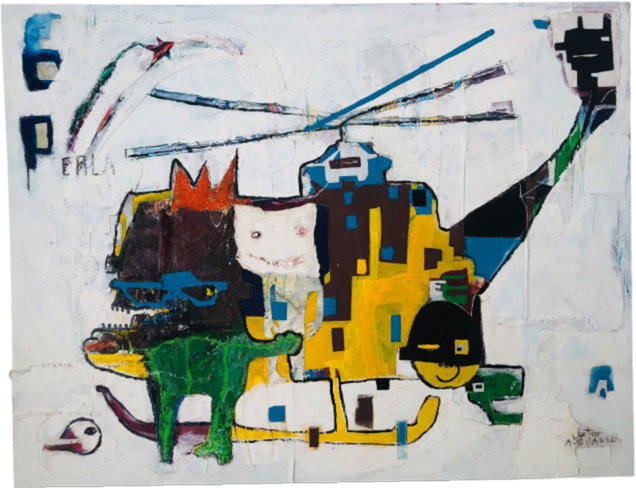
OBJETOS DE PODER: Apuntes sobre un proceso en residencia
Resultado de una residencia artística en Cacao Cultura, Objetos de poder reúne un conjunto de obras recientes de Víctor Avellaneda que exploran la relación entre materialidad, experiencia cotidiana y carga simbólica. Más que presentar conclusiones, el proyecto da cuenta de un proceso de trabajo atento al contexto, a lo disponible y a las tensiones entre lo manual y lo digital.
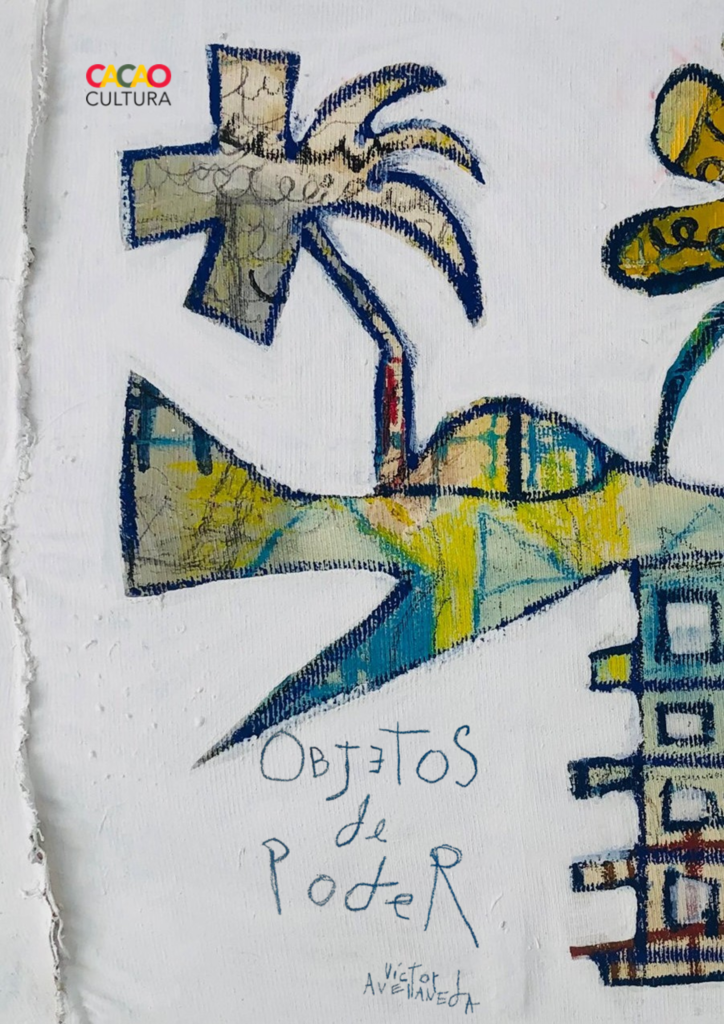
Habitar un espacio que no es propio implica, antes que nada, un ejercicio de atención. Durante su residencia en Cacao Cultura, Víctor Avellaneda asumió ese desplazamiento no como una interrupción de su práctica, sino como una oportunidad para escuchar lo que el lugar —sus ritmos, sus materiales, sus restos— tenía para decir. De ese gesto paciente surge Objetos de poder, un conjunto de obras que no busca imponer significados ni clausurar lecturas, sino explorar cómo ciertos objetos, aparentemente menores o inservibles, pueden concentrar experiencia, memoria y afecto. Más que resultados, estas piezas registran un modo de estar: trabajar con lo disponible, atender a lo obsoleto, permitir que el hacer manual dialogue con una cotidianidad atravesada por lo digital y lo fragmentario.
La residencia operó, en ese sentido, como un tiempo de ajuste fino. Lejos de cualquier idea de retiro o aislamiento, el trabajo se desarrolló en contacto directo con el entorno y con una materialidad que no se presenta como neutra. Pintura, cerámica y objeto conviven aquí sin jerarquías, como partes de un mismo sistema de exploración donde lo utilitario, lo simbólico y lo residual se rozan constantemente. Hay en estas piezas una voluntad de no separar el hacer artístico de la experiencia cotidiana: trabajar con lo que se tiene a mano, aceptar la imperfección del gesto, permitir que el error y la acumulación formen parte del proceso.
Más que una serie cerrada, Objetos de poder se configura como un campo de pruebas. Los objetos no ilustran ideas previas ni aspiran a una lectura única; funcionan, más bien, como condensadores de sentido. En ellos se cruzan referencias a lo digital, a la fragmentación de la experiencia contemporánea y a una dimensión casi ritual del trabajo manual. Sin estridencias, las obras activan preguntas sobre aquello que valoramos, conservamos o desechamos, y sobre cómo ciertos restos —materiales o simbólicos— pueden adquirir una carga significativa en contextos específicos.
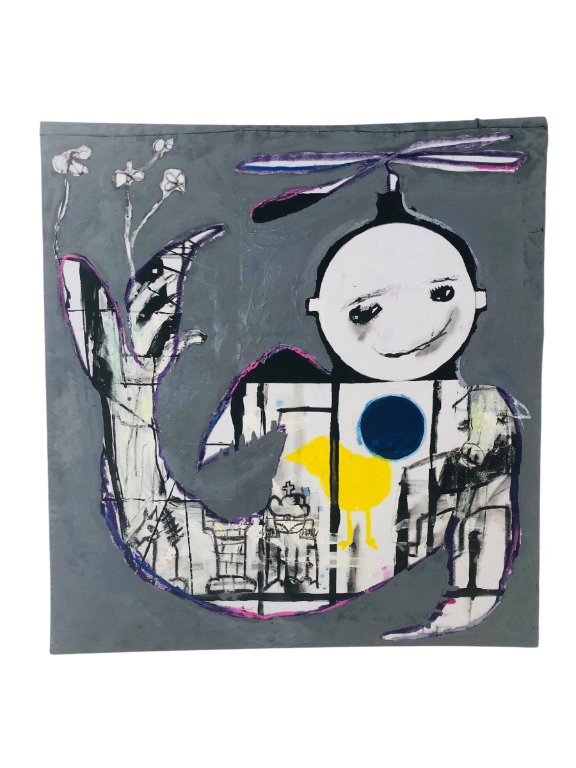
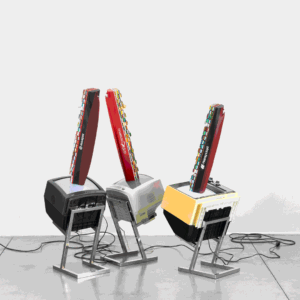
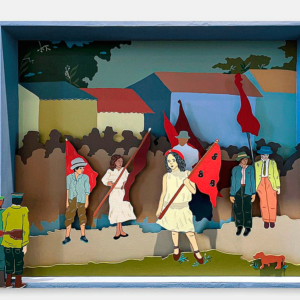
En el conjunto de obras reunidas bajo este título, la pintura, la cerámica y el objeto no funcionan como disciplinas separadas, sino como lenguajes que se contaminan entre sí. Hay una atención sostenida al fragmento, a la acumulación y al ensamblaje, como si cada pieza fuera el resultado de una negociación constante entre control y deriva. Los colores, las texturas y las formas no buscan seducir desde la perfección formal, sino establecer una relación directa con quien observa, apelando a una familiaridad extraña: algo que parece reconocible, pero que no termina de acomodarse del todo.
En este trabajo, lo manual no se presenta como gesto nostálgico ni como oposición frontal a lo digital. Por el contrario, ambos registros conviven en tensión. Referencias a píxeles, sistemas, organismos híbridos o fragmentaciones tecnológicas aparecen traducidas a un lenguaje matérico, imperfecto, táctil. Esa traducción —del dato a la mano, de la pantalla al objeto— introduce una distancia necesaria, un tiempo más lento que permite reconsiderar la manera en que producimos, consumimos y otorgamos valor a las cosas que nos rodean.
Los llamados “objetos de poder” no remiten aquí a una noción fija de fetiche o amuleto, sino a una carga simbólica que se construye en el uso, en el contexto y en la experiencia. Son piezas que no aspiran a imponerse, sino a permanecer disponibles, abiertas a lecturas múltiples. En ellas, lo inservible, lo descartado o lo aparentemente menor adquiere una presencia que invita a detenerse y a reconsiderar su lugar dentro de un ecosistema cotidiano saturado de estímulos y de información.
Leído en su conjunto, este cuerpo de trabajo no propone respuestas cerradas ni conclusiones definitivas. Más bien, señala un modo de proceder: observar con atención, trabajar con lo disponible y aceptar que el sentido se construye de manera progresiva, a veces incluso contradictoria. En ese desplazamiento constante, Objetos de poder se afirma menos como una serie concluida que como una etapa dentro de un proceso en curso, abierto a nuevas derivas y contextos. Un trabajo que no se agota en la experiencia de la residencia, sino que deja planteadas preguntas que pueden seguir activándose en el tiempo.
OBJECTS OF POWER: Notes on a Residency Process
The outcome of an artistic residency at Cacao Cultura, Objects of Power brings together a group of recent works by Víctor Avellaneda that explore the relationship between materiality, everyday experience, and symbolic charge. Rather than presenting conclusions, the project bears witness to a working process attentive to context, to what is available, and to the tensions between the manual and the digital.
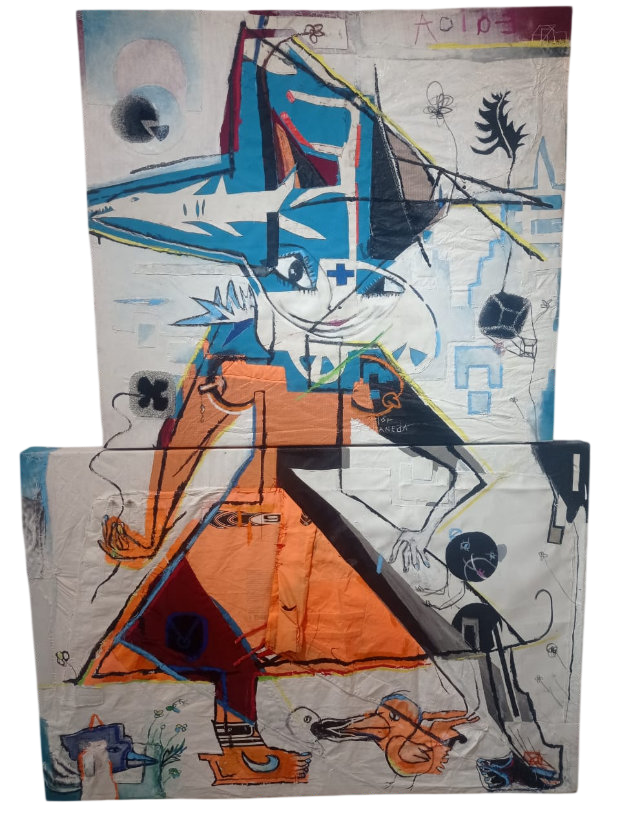
To inhabit a space that is not one’s own implies, above all, an exercise in attentiveness. During his residency at Cacao Cultura, Víctor Avellaneda approached this displacement not as an interruption of his practice, but as an opportunity to listen to what the place—its rhythms, its materials, its remnants—had to say. From this patient gesture emerges Objects of Power, a body of work that does not seek to impose meanings or to close off interpretations, but rather to explore how certain objects, seemingly minor or useless, can concentrate experience, memory, and affect. More than outcomes, these pieces register a way of being: working with what is available, attending to the obsolete, allowing manual making to enter into dialogue with an everyday life shaped by the digital and the fragmentary.
In this sense, the residency functioned as a time of fine adjustment. Far from any notion of retreat or isolation, the work developed in direct contact with the environment and with a materiality that does not present itself as neutral. Painting, ceramics, and object coexist here without hierarchies, as parts of a single system of exploration in which the utilitarian, the symbolic, and the residual constantly brush against one another. There is in these works a clear intention not to separate artistic making from everyday experience: to work with what is at hand, to accept the imperfection of the gesture, and to allow error and accumulation to become part of the process.
More than a closed series, Objects of Power takes shape as a testing ground. The objects do not illustrate preexisting ideas nor aspire to a single reading; rather, they function as condensers of meaning. Within them intersect references to the digital, to the fragmentation of contemporary experience, and to an almost ritual dimension of manual labor. Without stridency, the works activate questions about what we value, preserve, or discard, and about how certain remnants—material or symbolic—can acquire a significant charge within specific contexts.
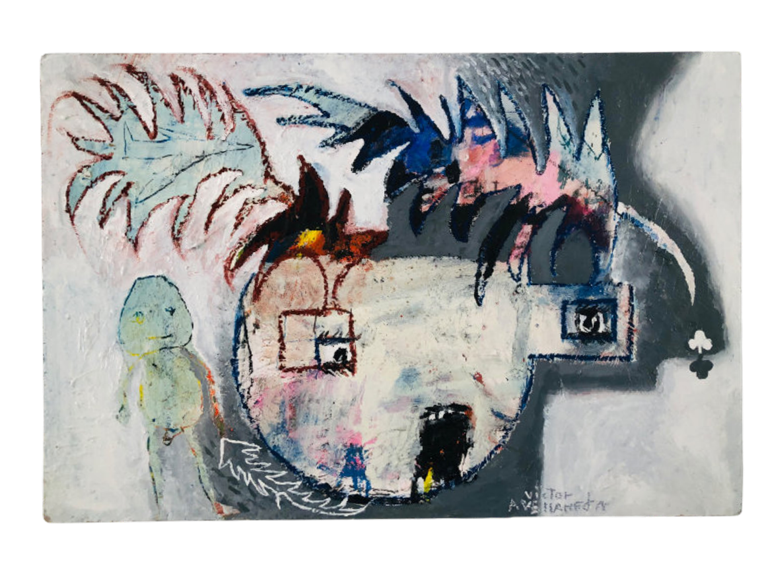
Across the body of works gathered under this title, painting, ceramics, and object do not operate as separate disciplines, but as languages that contaminate one another. There is a sustained attention to the fragment, to accumulation, and to assemblage, as if each piece were the result of a constant negotiation between control and drift. Colors, textures, and forms do not seek to seduce through formal perfection, but to establish a direct relationship with the viewer, appealing to a strange familiarity: something that seems recognizable, yet never fully settles into place.
In this work, the manual does not present itself as a nostalgic gesture nor as a frontal opposition to the digital. On the contrary, both registers coexist in tension. References to pixels, systems, hybrid organisms, or technological fragmentations appear translated into a material, imperfect, tactile language. This translation—from data to hand, from screen to object—introduces a necessary distance, a slower tempo that allows for a reconsideration of the ways in which we produce, consume, and assign value to the things that surround us.
The so-called “objects of power” do not refer here to a fixed notion of fetish or amulet, but to a symbolic charge constructed through use, context, and experience. They are pieces that do not aspire to impose themselves, but to remain available, open to multiple readings. In them, the useless, the discarded, or the seemingly minor acquires a presence that invites us to pause and reconsider its place within an everyday ecosystem saturated with stimuli and information.
Read as a whole, this body of work does not propose closed answers or definitive conclusions. Rather, it points to a way of proceeding: observing attentively, working with what is available, and accepting that meaning is constructed progressively, sometimes even contradictorily. In this constant displacement, Objects of Power asserts itself less as a concluded series than as a stage within an ongoing process, open to new drifts and contexts. A body of work that does not end with the experience of the residency, but instead leaves questions in motion, capable of continuing to activate themselves over time.
VALENCIA, VENEZUELA
Cesar Sasson
Magíster en Curaduría de Arte
coleccionsasson@gmail.com
@coleccionsasson
Ciudad de Panamá – Panamá
Enero 2026